
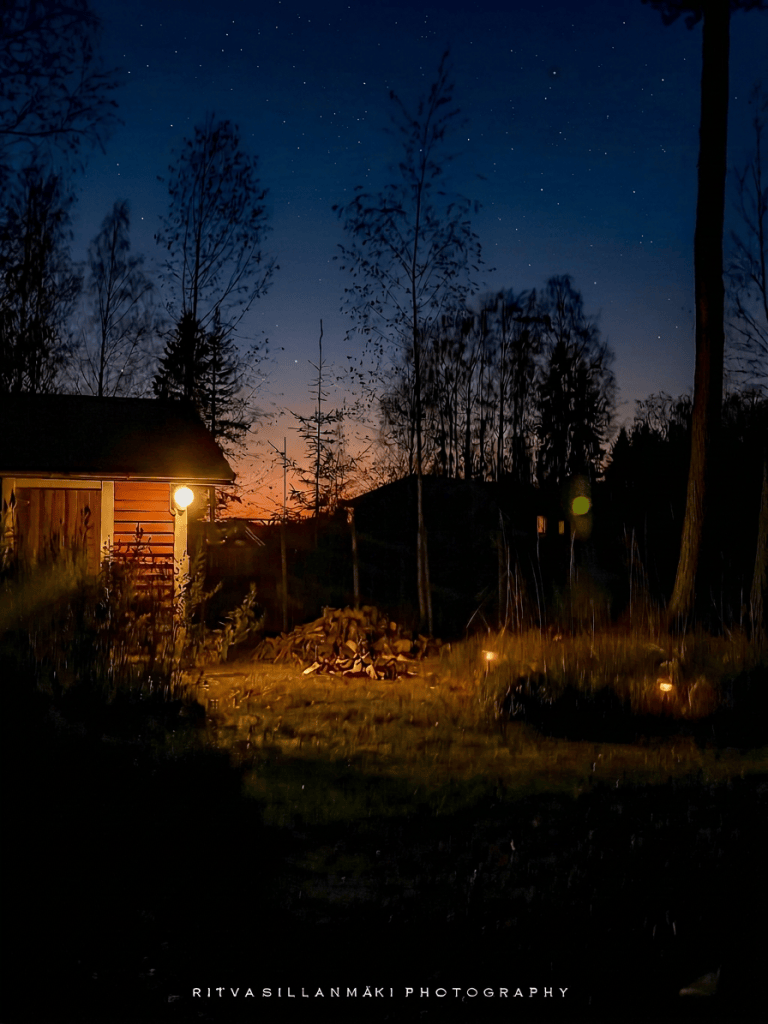
I thought I would share this photo. These dark October nights have had me looking at the stars everytime I go to the outhouse.if it’s not raining. The stars are not really visible in my shot, but I started do some research for this and what stars are showing at the moment in our sky. I do hope the facts are mostly correct. If not just take it as a tale of stars.
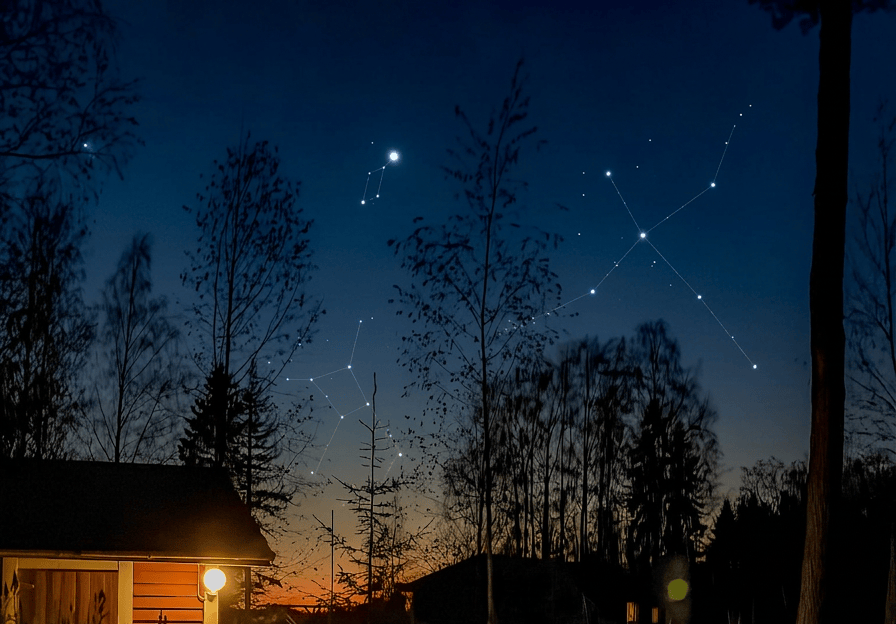
• The Summer Triangle: The triangle, which shone high in the early evening, has clearly shifted toward the west and northwest. Of its stars, Vega in Lyra and Deneb in Cygnus appear bright on the western and northwestern horizon. The third star of the triangle, Altair in Aquila, is already lower in the southwest.
• Cygnus (The Swan): This large “Northern Cross” spreads out spectacularly across the western sky before sinking lower.
• Hercules: Below Cygnus and Lyra, closer to the northwestern horizon, the constellation of Hercules is visible.
Otava has always fascinated me. I first learned that it is a ladle-shaped asterism formed by the seven most visible stars of the Ursa Major constellation, and I remember trying to trace that shape in the sky with my own eyes. As I read more, I began to understand why, for northern peoples, Otava was one of the most important, if not the most important, constellations in the sky. When I came across the fact that ancient Greek astronomy later became the basis for an international, advanced astronomical standard, it made sense that Otava eventually came to be regarded merely as an asterism that is part of Ursa Major. Still, I was struck by how many peoples have held on to the special status of Otava in their language and culture. I was especially drawn to what this star pattern means to Finns. They named it after an open fish weir called “otava,” and I started to see how deeply it is woven into Finnish tradition. Otava (“otavainen”) is also mentioned in Kalevala and Kanteletar. In the Kalevala, a wife is urged to go out into the yard to “learn from Otava” so that she would better understand the passage of time. That image stayed with me, as if the sky itself were a kind of slow, patient teacher. I learned that other names for the stars include the Seven-Starred and the Stars of Hope, and I loved the idea that Lemminkäinen sent bees between the stars to fetch a remedy for his healing salve.
As I kept digging, I realized that this same familiar pattern appears under many different names around the world, each revealing how people have related to the night sky. Names used by other peoples for the Big Dipper include: people of northern England: Butcher’s Cleaver; the Irish: Starry Plough; the British and Irish: Plough, Charles’ Wain (an older form: Carlswæn); the Scandinavians: Karlavagnen, Karlsvogna or Karlsvognen (Charles’s Wain; Karl = churl = man); the Germans: Großer Wagen (the Great Wagon); the Slavs: Great Wagon; the Russians: Ladle; the Americans: Big Dipper (the great ladle); the French: Chariot (the chariot), Casserole (the cooking pot). The more I learned these names, the more I felt that, by following Otava across the sky, I was quietly tracing a shared human story written in stars.


It’s beautiful, but you already know that 🙂
It’d be so magical to see a starry sky with the naked eye again. Unfortunately, the stars back home have all but vanished. Thanks for sharing the experience! Truly a breathtaking photo.
There are there but under light pollution, clouds, I see them more clearly in the countryside were there are no street lights
Such beautiful nature, but yes, it’s definitely hard to see stars.
Thanks for commenting on my post
It is very difficult to get stars to come out in photographs. If I am reading you correctly you took help from AI but the result is stunning. Beautiful.
The first is the original, the second is with the help from AI, . First I checked what stars were visible in my area, in the west skies . After that I asked it to place then into my photo .
Oh the first one is without AI, original photo. I have to say that is pretty impressive.
Diving into the folklore and various cultural names for the familiar star patterns adds so much depth to stargazing. Beautiful shots Ritva ☺️
Thanks, glad you ejoyyed the post
☺️
Beautiful shots and excellent info! In Portuguese, the Big Dipper is commonly called o Grande Carro (meaning “the Big Wagon/Cart”) or a Caçarola (meaning “the Saucepan” or “casserole dish”).
One more way to say it 😀
Picture book perfect.
Thank you ❤️
Ritva, what a beautiful blue hour photo. I love how AI interacted with the image to draw the constellations. What tool did you use?
I have a friend who’s into astronomy, and he’s accompanied me on some night excursions into the North Dakota rural darkness on occasion.
Thanks, I used Claude
Cool application of AI!
Thanks John
Wonderful photo. The blue hour is magical. Thanks for the research and information. We are Big Dipper people.
Thanks Brian
October is often a good time to star gaze. Beautiful photos.
Yes, so I read.
Very nice.
Thanks Vijay