

I was just thinking about where to point my camera during this time. Should I capture the Devil’s-bit scabious that’s either blooming or fading away, showcasing its intricate details and vibrant colors? Or maybe I should focus on the grass, which I believe is Calamagrostis epigejos, swaying gently in the breeze, its delicate blades reflecting the soft light? Then there’s also the Sow thistle, with its bright yellow blooms, and the cotton grass, which adds an ethereal quality to the landscape with its fluffy tufts dancing above the ground. What do you think? I did focus on all of them, keeping little distance so I could capture a mood I was aiming for – soft and light – delicate, evoking a sense of tranquility and harmony within nature. Each element plays a vital role in this ephemeral scene, weaving together a tapestry of colors and textures that resonate with the serene ambiance of the moment.
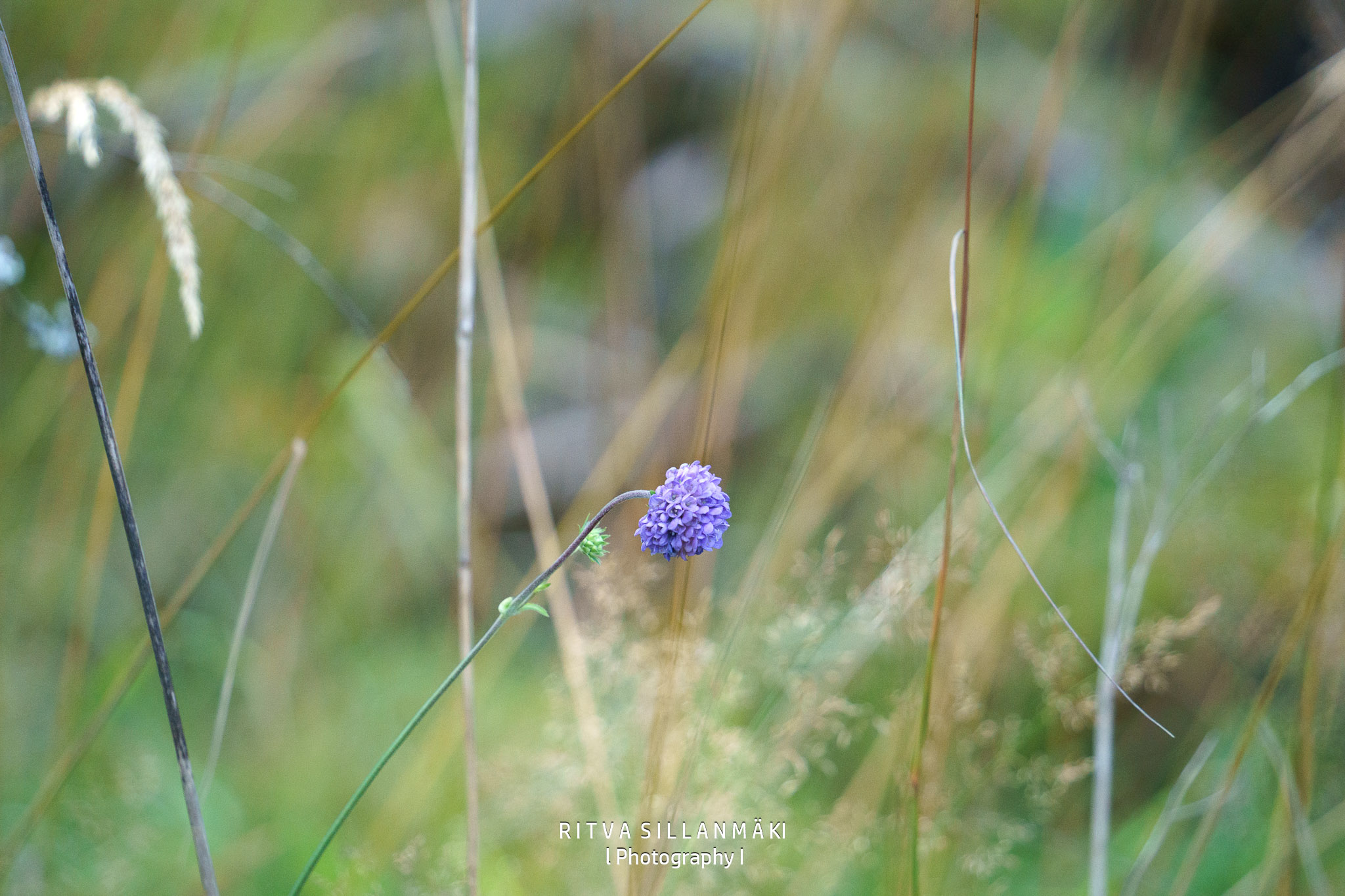
Devil’s-bit scabious’s inflorescence resembles that of field scabious (Knautia arvensis), but differs in having smaller ray-florets and distinct leaf shapes. The two plants typically inhabit opposite environments; field scabious thrives in dry sands, whereas devil’s-bit prefers heavy clay areas. It is found in clearings, damp meadows, and along coastal regions, mainly in the west and south-west, with a distribution limit in central Finland. A historical climate barrier exists between coastal and inland populations, attributed to post-Ice Age climatic changes. The species has since spread to newer shorelines. LuontoPortti
Devil’s-bit scabious has a history of use as a dye, seasoning, tea, and medicine for various ailments. Legend has it that the Devil attempted to destroy the plant by biting off its root, which appears damaged as it ages. Its names are derived from the Latin term succidere, meaning “to break from the bottom.” This plant also supports insects, particularly butterflies and bees, as they prepare for winter.
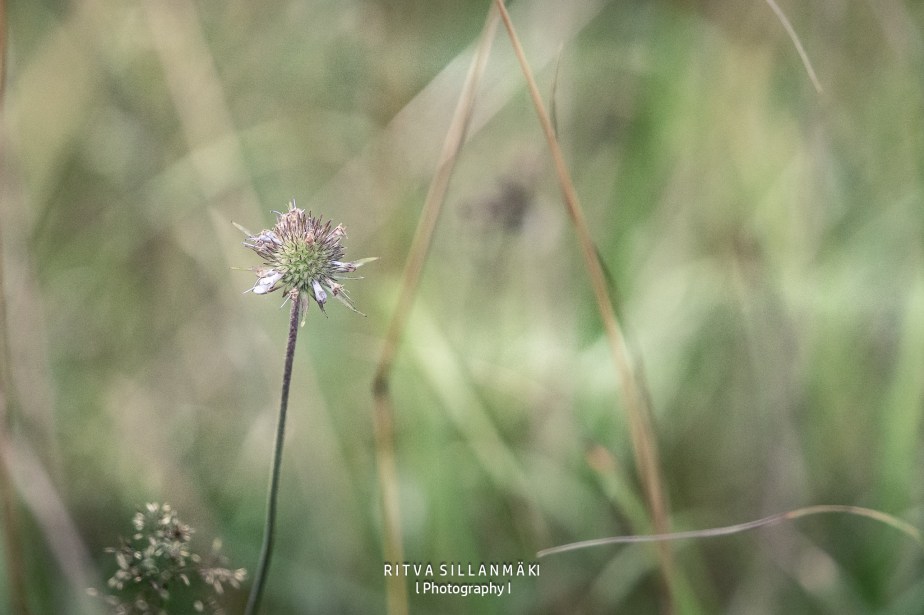

I think this grass is Hietakastikka (Calamagrostis epigejos), a perennial large grass species that thrives in a variety of habitats, often found in coastal areas and along riverbanks. It can be identified by its dense and large panicles, which are notably more pronounced compared to other Northern European grasses, contributing to its striking appearance. The spikelets, which are gray-green or bluish-brown, add to its visual appeal, especially when swaying gently in the wind. This species is not only valued for its aesthetic qualities but also plays a vital role in stabilizing soil and providing habitat for various wildlife, making it an essential component of the ecosystems it inhabits.


Sormipaisukarve (Hypogymnia physodes) is a type of lichen that grows on trees and rocks. It has become more common in recent years and is likely the most widespread lichen in Finland. This lichen is found throughout the country, especially in the south, and is rare in northern Lapland. Sormipaisukarve is a sign of air quality: in clean areas, it can grow up to five centimeters, while in polluted areas, it stays under one centimeter.

Cotton grass (Agrostis capillaris, syn. Agrostis tenuis) is a common grass species that thrives in a variety of habitats, including meadows, fields, and along roadsides. Its tall, slender stems and fine leaves create a delicate appearance, making it a notable feature in the landscape. Additionally, this grass species plays a vital role in the local ecosystem, providing food and shelter for various insects and small animals. It is an ancient introduction in Finland, where it has adapted to the climate and soil conditions, contributing to the rich biodiversity of the region.

The Sow thistle reached Finland after the Ice Age from the south and west. The populations from different directions are separate, and changes in distribution are very small on a human scale. The species grows in the Åland Islands and Uusimaa, mainly in the pine forests and edges of the Lohja region. Human activities do not threaten the species; instead, they often help it by creating more open areas with light, which the plant prefers. In some locations, it has even spread to roadsides and railway embankments.
Humans have also utilized sow thistle; the plant’s sturdy taproot is edible and tastes good. Instead of starch, the root contains inulin sugar, making it excellent for diabetics. One would think the sow thistle would stand out in the open pine forest, but its abundance and entire existence can go unnoticed, as it is often present only as leaf rosettes. The rosette somewhat resembles ribwort plantain (Plantago lanceolata), but the large flower heads that often open as early as May reveal that the plant belongs to the daisy family.


Lovely!
Thanks you
It would be nice if you also mentioned me the photographer as you share my post.
Beautiful
Thanks Caleb
These are amazing clicks. Wow! Mesmerised.
Thanks,glad you enjoyed them
🍿🍿🍿
😊
Calm, beautiful photos
Thanks, glad you enjoyed them
What a beautiful and thoughtful way to see nature.💜 The soft focus, delicate flowers, grasses, and quiet details create such a peaceful atmosphere. Sometimes the smallest things in nature hold the greatest beauty.
Thank you for stopping and having a look and commenting on my post
You’re most welcome 🤗
❤️
Thank you for stopping and having a look and commenting on my post
Beautiful photography and love the details about flowers. 🌷 Loved your well articulated article and pictures.
Thank you for stopping and having a look and commenting on my post
It is certainly a great post about photography as well as botany / flowers. There is a lot of interesting information here.
I really appreciate the way that you use visual focus alongside the informational focus in the text for each plant. I am certain that this post is going to influence how I direct my focus next time I’m taking photos.
Thank you for your lovely comment, I am happy you found it useful
Ritva, Beaitofi; post. I love how you used the soft backgrounds to focus on these different plants. The images are beautiful and I enjoyed your descriptions of each one.
I am so late responding to your comment. Life is rather hectic at the moment
Photography is a skill 👌
Yes it is and you have to work at it
I love how you explored the whole ecosystem instead of just locking onto one subject! That soft, dreamy mood you captured feels like the absolute essence of late August. Relieved to hear I’m not the only one who snaps away first and researches the flora names later! 😉
Thank you, I am happy that they look beautiful. Thanks for taking time to comment
Your photographs are wonderful
Beautiful post very enjoyable
Thank, glad you enjoyed it
Que publicação maravilhosa! Seu texto e suas escolhas fotográficas conseguem capturar algo que vai além do que os olhos veem; há uma emoção genuína que toca o coração e nos faz contemplar a beleza da criação divina. Focar em cada um desses elementos com essa sensibilidade sutil trouxe uma harmonia perfeita. Uma verdadeira obra de arte que transmite paz!
What a wonderful post! Your writing and photographic choices manage to capture something that goes beyond what the eyes can see; there is a genuine emotion that touches the heart and makes us contemplate the beauty of divine creation. Focusing on each of these elements with such subtle sensitivity brought a perfect harmony. A true piece of art that transmits peace!”
Thank you I am gad you enjoyed my post
Soft, light, serene – you nailed the mood beautifully with these images.
Thanks, I am glad you think so
Nature truly is incredible! Beautiful photos!
Thanks, Pamela nature is just that
Well, I’m glad you pointed your camera in all directions and photoed the lot! It was interesting to me that this was a post you could just as well prepared here in England as we have all these plants too. Good to know!
Now you know where to aim your camera 😀
😉
Ritva, I liked the way you focused on the entire scene and then cropped for particular areas. It was beautiful and a great lesson.
Thanks Anne, trying to capture some of the small and delicate things causet few unfocused shot too
😍
Answering your question with ‘all of them’ is the right answer, honestly. The cotton grass is what caught me — those fluffy tufts do something to a photo that no amount of sharp detail can. And the Devil’s-bit scabious caught between blooming and fading feels like exactly what late August looks like. Getting in close to hold that soft, delicate mood really paid off here.
Well Taylors, thanks for the comment and thoughts about my post. I am gald you enjoyed it.
You make me think . . . for that I am grateful . . . it is too easy for a city girl used to roses and tulips in vases not to know the name or the story . . . or the fact that these too have a life . . .
Well, city girls have beautiful bouquets and I also love them
🤦🏻♂️ Anyone who knows me, will tell you I haven’t a clue about flowers or anything from nature, so I really enjoyed your post.
So I guess it’s all about the photographs for me and of course, your images were excellent!!👌🏻
Mark, that is me also, it is about Photography – I do the research afterwards – and only sometimes 😁😉 Thanks !
👌🏻Now that makes me feel a lot better!! Thanks for that😁!
Haha this is also me, I rarely know what I am photographing 🤣